Introduction
As global demand for flexible, affordable, and eco-friendly housing grows, container houses have become one of the most popular modern prefab solutions. They combine mobility, cost-efficiency, and fast installation, making them ideal for both residential and commercial use — from temporary worker camps and construction offices to resorts and off-grid homes.
Among all modular options, foldable container houses and expandable container houses are two of the most in-demand designs. Each offers unique strengths that suit different needs.
In this article, we’ll compare both types in detail — their definitions, features, pros and cons, and ideal use cases — to help you choose the right solution for your project.
A foldable container house is a modular building designed to fold flat during transport and unfold on-site within hours.Built with a galvanized steel frame and lightweight insulated panels, it’s engineered for easy relocation and rapid setup. Once delivered, the house can be unfolded manually, fixed in place, and connected to power and water — ready to use the same day.
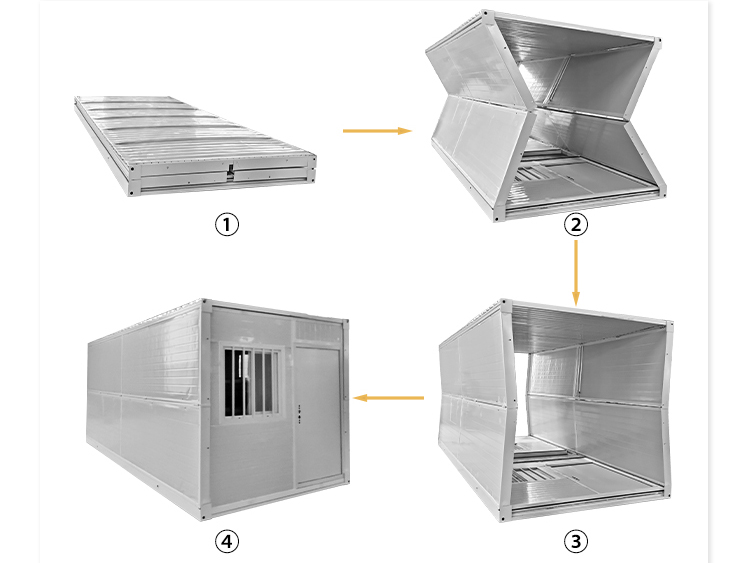
Advantages of Foldable Container Houses
- Exceptional Transport Efficiency
A foldable container house can be compressed to just a fraction of its height — often under 45 cm per unit. This means a 40HQ shipping container can carry multiple units, drastically cutting shipping and logistics costs.
- Fast Installation
Foldable container homes are factory-preassembled, so installation on-site takes only a few hours. With minimal labor and basic tools, the structure is ready to use almost immediately.
- Highly Flexible & Mobile
Ideal for projects that require frequent relocation — such as construction camps, emergency shelters, or mobile offices.
- Cost-Effective Solution
Lower shipping and installation costs make it a great budget-friendly choice for short-term or portable housing projects.

Limitations of Foldable Container Houses
While foldable houses offer great mobility and speed, they also come with a few trade-offs:
- Compact interior space, not ideal for long-term living
- Limited insulation, requiring high-quality panels for extreme climates
- Folding joints may need regular maintenance or reinforcement
- Roof load capacity is lower unless additional support is added
- Prone to corrosion in humid or coastal areas (requires regular painting and sealing)
- Industrial appearance, which may need extra design customization
Despite these, foldable container homes remain one of the best options for temporary, fast-deploy, and cost-conscious projects.
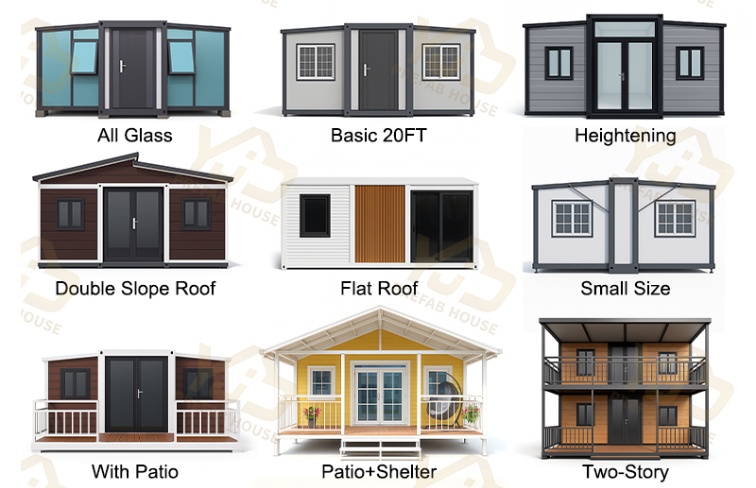
An expandable container house is an upgraded modular home that can expand horizontally or vertically to provide more living space.During transport, the unit stays compact. Once on-site, the side walls or modules slide out or unfold, creating a spacious interior suitable for residential, office, or commercial use.

Advantages of Expandable Container Houses
- Spacious & Comfortable
When expanded, the usable space often doubles or triples, providing a more livable environment.
- High Customization
Expandable houses can be designed for various applications — homes, offices, showrooms, or cafés. Buyers can choose layouts, colors, materials, and interior designs to match their project style.
- Durable & Safe
Built with anti-corrosion steel frames and tested under strong wind and load conditions, they ensure long-term stability and reliability.
- Sustainable & Eco-Friendly
Expandable homes are made with recyclable materials and can integrate solar panels, rainwater systems, and energy-saving insulation.
- Quick Setup
Each unit is prefabricated in the factory, ensuring consistent quality and reducing on-site labor. Delivery-to-installation can be completed in just 1–2 days.
Limitations of Expandable Container Houses
- Slightly higher upfront cost than foldable types
- Local permit compliance may vary by country or region
- Still compact compared to traditional homes (smart layout design is essential)
- Requires professional setup to ensure smooth expansion mechanisms
However, for buyers who value comfort, aesthetics, and long-term usability, expandable container houses offer an excellent balance between flexibility and functionality.
3. Comparison: Foldable vs Expandable Container House
| Feature |
Foldable Container House |
Expandable Container House |
| Transport Efficiency |
Extremely high – multiple units per container |
High – compact but larger when unfolded |
| Installation Time |
1–3 hours (very fast) |
4–8 hours (fast) |
| Space After Setup |
Compact interior |
Larger, comfortable living area |
| Customization |
Basic – limited layouts |
High – customizable design |
| Durability |
Good, needs regular maintenance |
Excellent, strong steel structure |
| Insulation |
Requires high-quality panels |
Factory-installed insulation systems |
| Best Use Case |
Temporary housing, mobile sites, disaster relief |
Homes, offices, resorts, retail spaces |
4. Which One Should You Choose?
Choosing between foldable and expandable container houses depends on your project needs:
-
Choose a Foldable Container House if you need:
✔️ Fast setup and easy transport
✔️ Frequent relocation
✔️ Temporary or emergency housing
-
Choose an Expandable Container House if you need:
✔️ More living space and comfort
✔️ Long-term use or commercial applications
✔️ High customization and better aesthetics
Both are smart, eco-friendly solutions — but serve different purposes.
Conclusion
Both foldable and expandable container houses represent the future of modular architecture — fast to build, easy to move, and designed for modern living.
If you need speed and portability, a foldable house offers unbeatable efficiency.
If you value comfort, design, and flexibility, an expandable house will be your best long-term investment.
Looking for a reliable prefab house manufacturer in China?
We specialize in custom-designed foldable and expandable container houses that combine durability, modern aesthetics, and affordability.
Contact us today for a free quotation and layout design —
📧yjd@yjdhouse.com
Tel:+8618698398668


